RHINO: Reconstructing Human Interactions with Novel Objects from Monocular Videos
Abstract
Computer Vision and Pattern Recognition – CVPR 2026
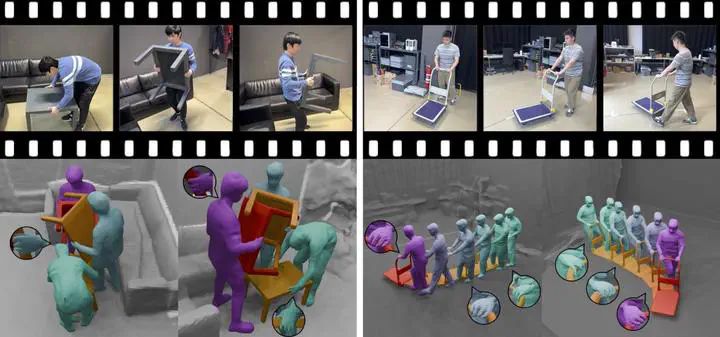
Reconstructing people, objects, and their interactions in 3D is a long-standing and fundamental goal for intelligent systems. Often the input is RGB video from a moving camera, making the task ill-posed; depth is ambiguous, humans and objects occlude each other, and camera and object motion entangle to create apparent motion. Most prior work addresses humans or objects in isolation, ignoring their interplay, or assumes known 3D shapes or cameras, which is impractical for real-world applications. We develop RHINO (Reconstructing Human Interactions with Novel Objects), a novel three-step framework that recovers in 3D a human, novel (unseen) manipulated object, and static scene in a common world frame from a monocular RGB video. First, we leverage 3D-aware foundation models to obtain cues that stabilize Structure-from-Motion (SfM) even for low-texture regions; this yields a coarse shape and apparent motion of a manipulated object from foreground pixels, and a coarse scene shape and camera motion from background pixels. Second, we estimate a human in the camera frame via an off-the-shelf method, and subtract the camera motion from apparent motion to extract the object motion; this registers the human, object, and coarse scene shapes into a common world frame. Third, we refine shapes using a compositional neural field with per-component signed- distance fields. The latter further enables differentiable contact priors that attract surfaces while penalizing interpenetration, improving the physical plausibility of the final reconstruction. For evaluation, we capture a new dataset of handheld monocular videos synchronized with a volumetric 4D capture stage, providing ground-truth shape and camera motion. RHINO outperforms state-of-the-art baselines on novel-view synthesis and 4D reconstruction. Ablations show that each stage contributes substantially. Code and data are available at https://lxxue.github.io/RHINO.

Lixin Xue
Co-advising with
M. Pollefeys & O. Hilliges (ETH)
Interns as PhD: Apple

Georgios Paschalidis